Once upon a time in Glengarry...
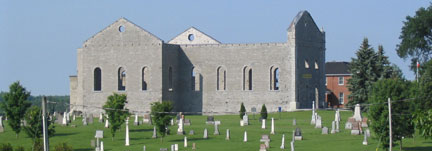
The story of the 1785 emigration to Canada cannot be established definitely in all its detail, but when documentary and oral sources are put together, a cohesive narrative of the emigrants journey to Canada emerges. The emigrants left Scotland under the leadership of Allan MacDonell. Later a Justice of the Peace in Glengarry County and described as "Esquire, " MacDonell was born at Inchlaggan on the Glengarry estate in 1746. (His younger brother Alexander, later Bishop MacDonell of Kingston, was a commanding figure in Canadian history)
I have a book called Scottish Lights. Popular Essays on Cape Breton and Eastern Nova Scotia
"Celtic Heritage, Humour, Pioneer Life, Nicknames, War... AND MORE!"
by AA MacKenzie
without permission...
MANY YEARS AGO, a Skye man, Dr. Norman McLeod -- not the Norman of Cape Breton
and New Zealand fame -- was visiting Canada. On a boat out of Kingston, on Lake Ontario, he heard voices in a Gaelic chorus. Rounding the deckhouse, he found 12 Highlanders singing.
The minister began to question them in English.
" Pray, what language is that?"
"Gaelic, sir."
"Where is it spoken?"
"Indeed, sir, in the Highlands of Scotland."
"Is it really a language?"
"It is the only true language! English is no language at all."
"It must be banished! It is savage!"
"It's not you or any other that will banish it!"
"Pray, ask me a question in it."
"Ach will, co a's thainig thu? (Where do you come from?)"
"Thainig mide a's an Eilean agiathanoch! ( I came from the Isle of Skye!)"
"O fheudail! S'e Gaidheal a th'ann! ( Oh dear! He's a Gael!);
Dr. McLeod said they were all Glengarry men who had never set eyes on Scotland. Now that was in the early 1800's.
A century later, three Nova Scotians from Pictou County went up to seek jobs in the Ottawa Valley lumber woods. In one camp the foreman, a brawny Glengarry man named McIntosh, took their names and asked a few questions:
"Have ye worked in the woods before?"
Yes, was the answer; they all had experience.
"And by yer names, ye're Highlanders. Bi sibh bruidhinn Gaidhlig, tha mi'n duil? (you speak Gaelic, I suppose?)"
But the easterners, like most Pictou County people after 1900, had no Gaelic.
"Ach well! Too bad!" said the Glengarry man, dismissing them. "We were short of men, too!"
The people who settled the new Glengarry in south-eastern Ontario were from Lochbar and the Hebrides, most of them MacDonalds, MacDonells, MacMillans, MacGillivrays, McGillises, MacMasters, Grants, McIntoshes, McLeods, Camerons, Kennedys, and McMartins; other great names were there, too.
It is a wonderful book.... Scottish Lights
The Diocese of Alexandria
PAST & PRESENT
Mysterious Bell found in St. Finnan's parish in Alexandria
Have you heard about the original three relics of St. Finnan, disciple of St. Aide,
contemporary of St. Patrick, about which tradition has woven many strange tales.
The bell was lost, but recovered from the depths of the Lagan river.
It seems to have been in the custody of many clans, the McLennans,
the MacLaggans and the McDougalds. Tradition speaks
of it as religiously guarded in Lochaber, and devotion to St. Finnan was ever the
peculiar trait of Highlanders in the western part of Scotland.
This no doubt explains why St. Finnan was given as patron saint to the parish of
Alexandria, Ontario, since the great majority of the first settlers came from Lochaber.
If the crosier of St. Finnan came to Canada with the Dewars, why not the bell of
St. Finnan?
Who knows? Alexandria may be linked with the disciples of St. Patrick.
The Glen of my fathers no longer is ours. The Castle is silent and roofless its towers.The hamlets have vanished and grass, growing green. Now covers the hillocks where once they had been; The song of the stream arises sadly in vain, No children are here to rejoice in the strain. No voices are heard by Loch Oich's lone shore. Glengarry is here; but Glengarry no more. -- W. Allan
MacDonald, MacDonald, MacDonell of Apple Hill
"Yes, the repetition of names complicates the picture. It's
difficult for we moderns to comprehend the isolation of northern
Scotland in the 17 and 1800s. The names the only ones they knew.
They were further shackled by the belief that a child "took after"
the person whose names it was given as well as by the god parents.
So parents were careful to choose only names of people they
admired. Immigration to Canada brought increased isolation caused
by the real fear of starvation and the vast forests to get lost in,
containing bears and wolves and no roads. This served to increase
their interdependence. Northern Scotland was above the tree line.
Indians showed new settlers edible plants like cat-tails and
nettles etc. My mother said people often had only potatoes to
eat."
-- Christena
The Baldy Farm
Lot 29. The house and barn are long gone but last time I was at the lot one building remained at the south end. It was more of a shed. My cousin in Sudbury still has fairly clear memories of the properties as she grew up out there until she was around 10 or so.
I assume by next door to lot 29 it must be in regards to the farms around it. I am sure you know the road that leads from Apple Hill to Loch Garry. Lot 29 was known as "The orchard of Glengarry". Lot 29 was the second last farm before the road turns to the lake. The first farm west of Lot 29 was Dan C. MacDonald which was later owned by "Johnny Rod" John Roderick MacDonald. Next west was the Baldy farm which purchased by my Grandfather, Billy Muir. Next was Legault and Kinnear which was also purchased by Billy Muir. Next was Billy MacNamara, then Ranald Billy MacDonald, then Alex McMartin, then Johnny Leblanc. My Great Uncle Hampton Muir purchased the farm from my Grandfather Billy and later sold it to the Boy Scouts.
-- Terry
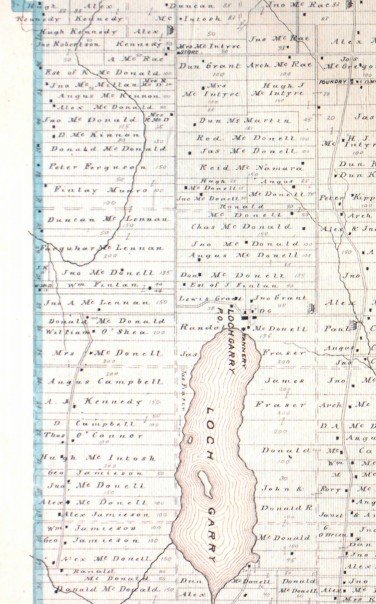
This is a cropped version showing concessions I and II, from Lot 16 to Lot 38.